

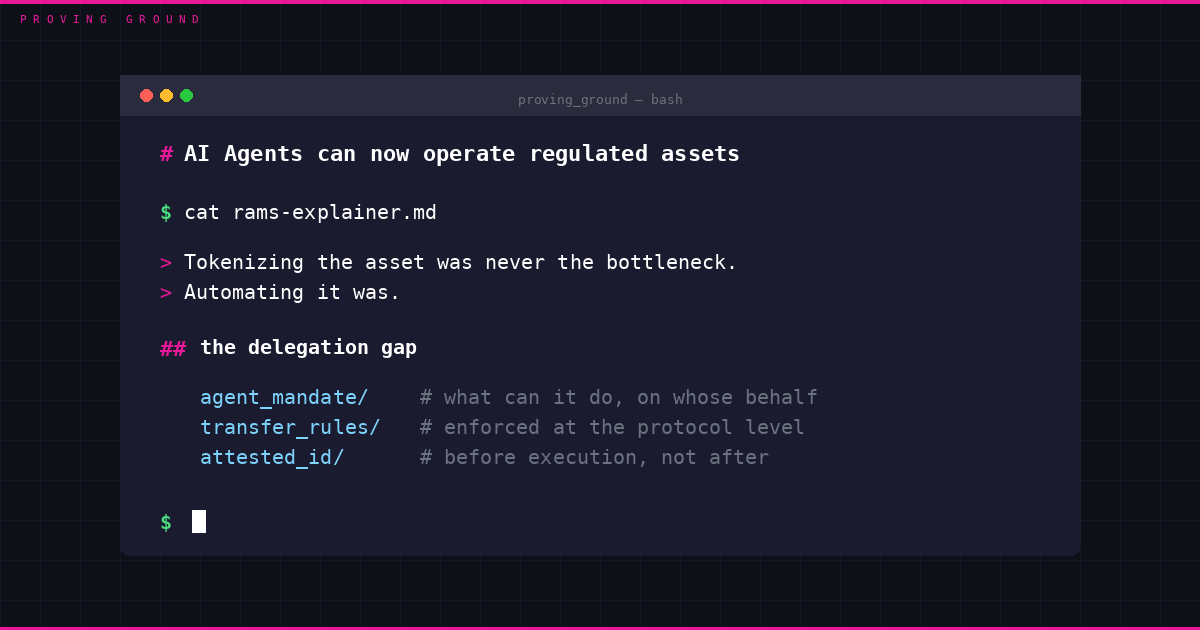
AI Agents can hold wallets, execute trades and settle payments without a human in the loop. What they still can’t do, in most stacks, is operate a regulated real-world asset. A bond, a private equity stake or a real estate share carries compliance rules that have to be enforced before every transaction executes. Without a standard that encodes those rules at the protocol level, every autonomous operation still needs a human to sign off. That standard now exists. It’s called RAMS.
The tokenization conversation has been running on one track for years. How much can you put on chain? The answer got very large very fast. The track nobody talks about is what happens after the asset is minted. Keeping it compliant, tracking ownership, enforcing transfer restrictions for years, for every new owner, across every secondary transaction. That operational layer is what separates a proof of concept from a running financial product. And it is the layer AI Agents need access to if they are going to do anything useful.
Why AI Agents can’t just execute transactions on tokenized assets
The asset is on chain. The agent has a wallet. So what’s stopping it?
Regulatory constraints are stopping it. Tokenized real-world assets are not like fungible tokens. A bond, a private equity stake and a real estate share each carry rules about who can hold them, when they can move and under what conditions a transfer is valid. Those rules are not optional. A transfer that violates them is not just invalid; it creates liability for the issuer.
The problem is delegation. How does an institution define what an AI Agent is allowed to do? On whose behalf? Within what limits? And how do you make that definition legally meaningful rather than a policy document that no system actually checks?
Without a standard that answers those questions at the contract level, every autonomous operation stalls the same way. A human has to approve before anything settles. You have tokenized the asset. You have not automated it.
What RAMS does for AI Agents operating regulated assets
RAMS (Regulated Agent Mandate Standard) is Brickken’s compliance delegation framework. It encodes agent authority directly at the protocol level so that every transaction an AI Agent initiates is checked against a machine-readable mandate before it executes.
A RAMS mandate defines what the AI Agent can do (execute transfers, trigger distribution events, rebalance positions), whose authority it acts under, which transfer restrictions apply and what it cannot do regardless of instruction. Each agent carries an attested identity. Every action it takes runs through RAMS-defined rules before the transaction settles.
This is not post-hoc auditing. The compliance gate runs before execution. An AI Agent operating under RAMS can move a tokenized asset through a fully automated workflow, overnight, at volume, without a human in the loop, and every step stays within the ownership and compliance controls the issuer requires.
That is a qualitatively different capability than what existed before. The asset is no longer just on chain. It is operable.
Why the execution environment matters for RAMS
A compliance standard that can’t handle sustained automated load is a compliance standard with nowhere to go. Tokenized assets under active management don’t generate one transaction at issuance and then go quiet. They generate compliance checks, ownership updates, dividend distributions and secondary transfers continuously, across the life of the asset.
Taiko is a Type 1 zk-EVM running Ethereum-equivalent execution secured by zero-knowledge proofs. Issuers bring existing Ethereum contracts with no migration required. Taiko handles the transaction volume that continuous agentic operations generate, at costs that make RAMS-gated automation viable at scale. Brickken’s full stack (WebApp, whitelabel product and direct API) runs natively on Taiko, so builders inherit the complete asset lifecycle including RAMS from day one.
Real-world assets and AI Agents are converging faster than most infrastructure was built to handle. The bottleneck is not issuance. It never was. It is whether an agent can operate the asset after it’s on chain, with the same compliance guarantees an institution needs. RAMS on Taiko is the answer to that question.
RAMS (Regulated Agent Mandate Standard) is Brickken’s compliance delegation standard for AI Agents operating regulated on-chain assets, enforced at the protocol level before transaction execution, now running natively on Taiko’s Ethereum-equivalent Layer 2.
This post is exploratory and does not represent a specific roadmap.