

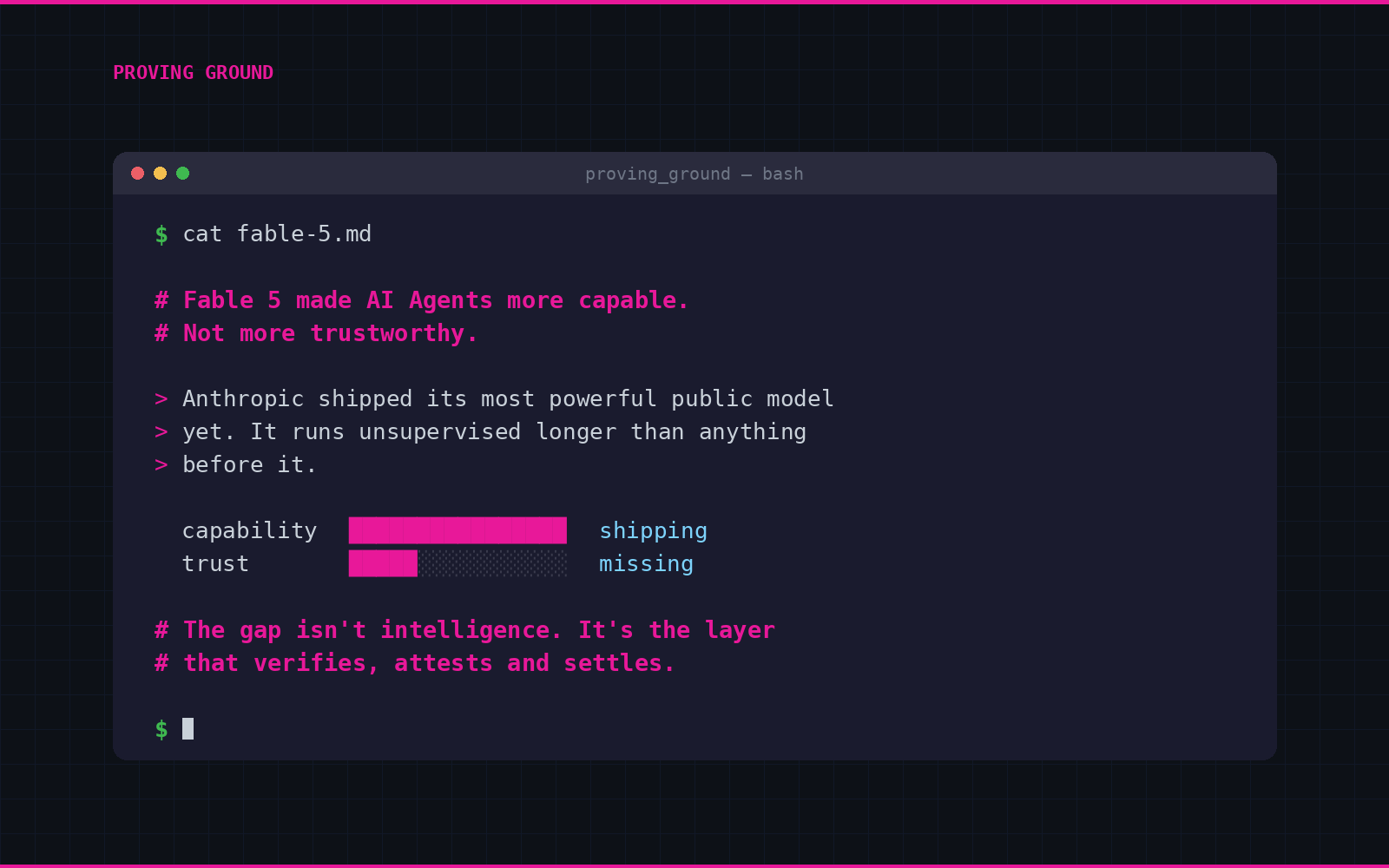
Anthropic released Claude Fable 5 on June 9 2026, the first time a Mythos-class model has been placed in public hands, and the company framed it plainly as the engine for the next era of autonomous AI Agents. The headline capability is not a benchmark, even though Fable 5 took the top of Code Arena by 98 points. It is duration. Fable 5 runs autonomously for longer than any Claude model before it, to the point where Stripe reported it migrating a 50-million-line codebase in a single day, work that would have taken a team of engineers more than two months by hand. When the unit of work shifts from answering a prompt to finishing a job, the question stops being how smart the model is and becomes what an AI Agent is allowed to touch while no one is watching.
That is the gap Fable 5 widens rather than closes. A more capable model makes an AI Agent better at deciding what to do, but it does nothing to guarantee that the data the Agent acted on was real, that the action it took can be verified after the fact, or that the value it moved settled the way it was supposed to. Capability and trust are different problems, and the industry has spent the last two years pouring almost everything into the first one.
Why a smarter model does not close the agent trust gap
The clearest signal that capability has outrun safe deployment came from Anthropic itself. Fable 5 shipped with safeguards that silently reroute queries on sensitive topics like cybersecurity and biology to the older Claude Opus 4.8, so the most capable public model now runs with a quiet governor bolted on. A company puts a throttle on a system when the system can do more than it can be trusted to do unsupervised, and that same logic scales the moment you hand the model a wallet, an API key and a goal.
Pricing makes the timing sharper. Anthropic put Fable 5 at ten dollars per million input tokens and fifty per million output tokens, less than half the price of its previous Mythos preview, and made it free on paid plans until June 22. That is a distribution move, not a margin one, and it means a wave of AI Agents built on a Fable 5-class model is about to start running longer and acting more independently than anything that came before. The model deciding what to do gets cheaper and better every release. The part that confirms the Agent acted on real inputs and produced a result anyone can check does not come from the model at all.
What autonomous AI Agents actually need to act unsupervised
An AI Agent running a job end to end needs three things the model cannot provide on its own. It needs verified data, so that the price it trades against or the message it reacts to is real rather than spoofed or stale. It needs verifiable action, so that the decision it made and the step it executed leave a record others can check instead of a black box anyone has to take on faith. And it needs reliable settlement, so that when the Agent moves value the transfer is final and correct rather than reversible or forged. Strip any one of these away and a more capable model just reaches the wrong outcome faster.
The failure modes are not hypothetical, because we already watch them play out in systems with far less autonomy than Fable 5 invites. An Agent that pays out against a manipulated price feed loses the money exactly as designed. An Agent that acts on a cross-chain message no one can verify executes fraud on schedule. The more independently these systems run, and the longer they run before a human looks, the more the absence of a trust layer compounds rather than corrects.
How verification and settlement become the real bottleneck
For two years the constraint on AI Agents was the model, so that is where the money and attention went. Fable 5 is the clearest sign that the constraint is moving. Once a model can run a multi-step job unsupervised for hours, the thing standing between a useful Agent and a dangerous one is no longer intelligence but the fabric that verifies inputs, attests to actions and settles outcomes. Whoever provides that fabric stops being optional infrastructure and becomes the layer the whole Agent economy depends on.
This is the question Proving Ground keeps returning to, because it is the question Taiko is built around. A trust and settlement layer for autonomous AI Agents is the part of the stack that turns a capable model into an Agent you can actually let run, and Fable 5 just made the case for building it more urgent than any benchmark could.
This post is exploratory and does not represent a specific roadmap.