
Most “Why AI?” answers are productivity slideware: save 40 minutes a day, cut errors, replace headcount. All true, and all a third of the actual question.
The real question splits in two: how do we make the current operation work harder and faster, and how do we open revenue surfaces that did not exist before? Both halves are moving at once, and most companies are running the first play while telling themselves they ran the second.
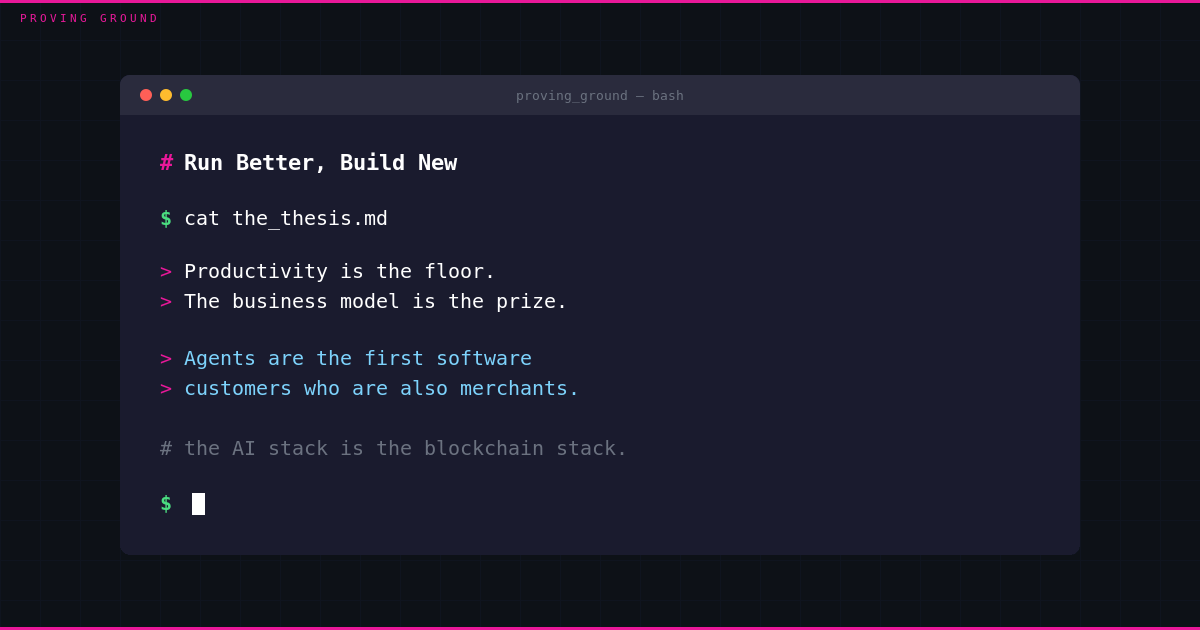
What’s actually new sits under the second half. Every software era before this had a clean separation between who bought software and who sold it. A human bought a CRM. A company bought a database. They used the software to do work and then converted that work back into human-to-human transactions before any money moved. Agents collapse that loop. They are the first software customers that can also be merchants, transacting directly with other agents they have never met, with no shared contract and no Stripe account between them. That is a structural change, not a feature, and it is what makes the AI stack and the blockchain stack the same stack.
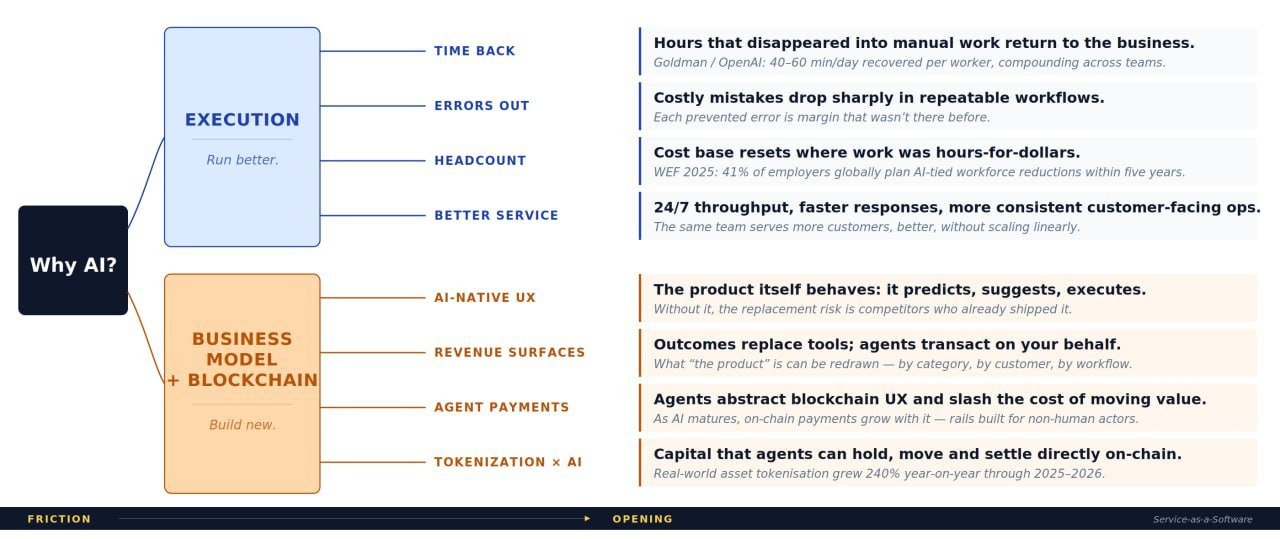
The Run Better levers are well-rehearsed, but the compounding across them is larger than most boards have priced in. Goldman and OpenAI put time recovered at 40 to 60 minutes per worker per day, which is a full week back for a 100-person team every week. Errors drop sharply in repeatable workflows, and each prevented mistake is margin that wasn’t there before. The WEF’s 2025 jobs report has 41% of employers globally planning AI-tied workforce reductions inside five years. The polite version is “redeployment.” The honest version is structural. And 24/7 throughput with the same team serving more customers is the part incumbents are racing on, because customers notice the difference inside a quarter.
All real, and all the floor. Run Better assumes the same business model you already have, just with cheaper inputs. Stop here and you have built a leaner version of yesterday’s company.
Build new
The second half is where the model itself shifts, and where the customer-as-merchant collapse plays out in practice.
AI-native UX. The product behaves rather than waits, predicting, suggesting and executing on the user’s behalf. Cursor rewrote what coding software looks like by collapsing the loop between intent and output. Devin pitched itself not as a tool for developers but as a developer. Static SaaS dashboards are the new on-prem.
Revenue surfaces. Outcomes replace tools. Intercom Fin charges by resolved ticket. Sierra by handled conversation. Harvey by completed legal work. The pricing is not a packaging choice. It is an admission that the customer was never buying software, only ever buying the thing the software produced. And once the customer of that outcome is itself another agent, the entire contracting model breaks.
Agent payments. Stripe and ACH were built for humans: phone numbers, chargebacks, shared business relationships. Agents have none of that. They cannot open bank accounts; they hold crypto wallets, transact in stablecoins and settle in real time without a human in the loop. When two agents from different organisations need to transact instantly, permissionless settlement is the only architecture that works. Public chains have had this from day one, and Layer 2s like Taiko have driven cost to fractions of a cent. Protocols like x402 hint at what these rails look like in practice. The infrastructure is being laid faster than most enterprises realise.
Tokenization x AI. Once agents can settle directly with each other, the capital they hold becomes the next question. Real-world asset tokenisation grew 240% year-on-year through 2025 to 2026, with BlackRock’s BUIDL and Ondo’s tokenised treasuries setting the early shape of the market. The pipes are getting built. What rides on them is software that owns money, settles its own deals and pays its own counterparties.
The half of the map that gets called speculative is the half where the structural shift is actually happening.
Service-as-a-Software
The footer of the map carries the punchline. For 20 years software modelled itself on services, with SaaS selling tools that humans used. The agent shift inverts the arrangement entirely. Software does the service. Software is the worker. Software is the buyer. Software is the seller. The unit of value is no longer a seat, and the unit of transaction is no longer human-to-human.
And underneath all of this sits a quieter truth. The biggest line in a traditional SaaS budget was never the licence. It was the people hired to make the licence work: the operators, analysts and customer success teams who configured, watched, interpreted and escalated on behalf of the software. That cost line is what the agent shift compresses. The largest expense of yesterday’s software is the one that disappears first.
You can run both plays at once. Most companies will run the first and quietly call it the second.
Three questions
Put these to your team this quarter.
Where in the operation are we still paying hours-for-dollars for repeatable work? That is a Run Better play with the ROI math already done.
What does our product do that an agent could do better? “Most of it” means the moat is gone. “None of it” means you have not looked hard enough.
What happens to our business when a portion of our customers are agents, and that agent’s customer is another agent? If you cannot answer that question with the rails you have today, you have your answer about which rails you need.
Agents are not a faster kind of user. They are a new economic actor that is simultaneously customer and merchant, transacting on rails that did not exist for any prior buyer of software. The companies that win this decade are the ones building for that actor.
This post is exploratory and does not represent a specific roadmap.