

DeFi bots
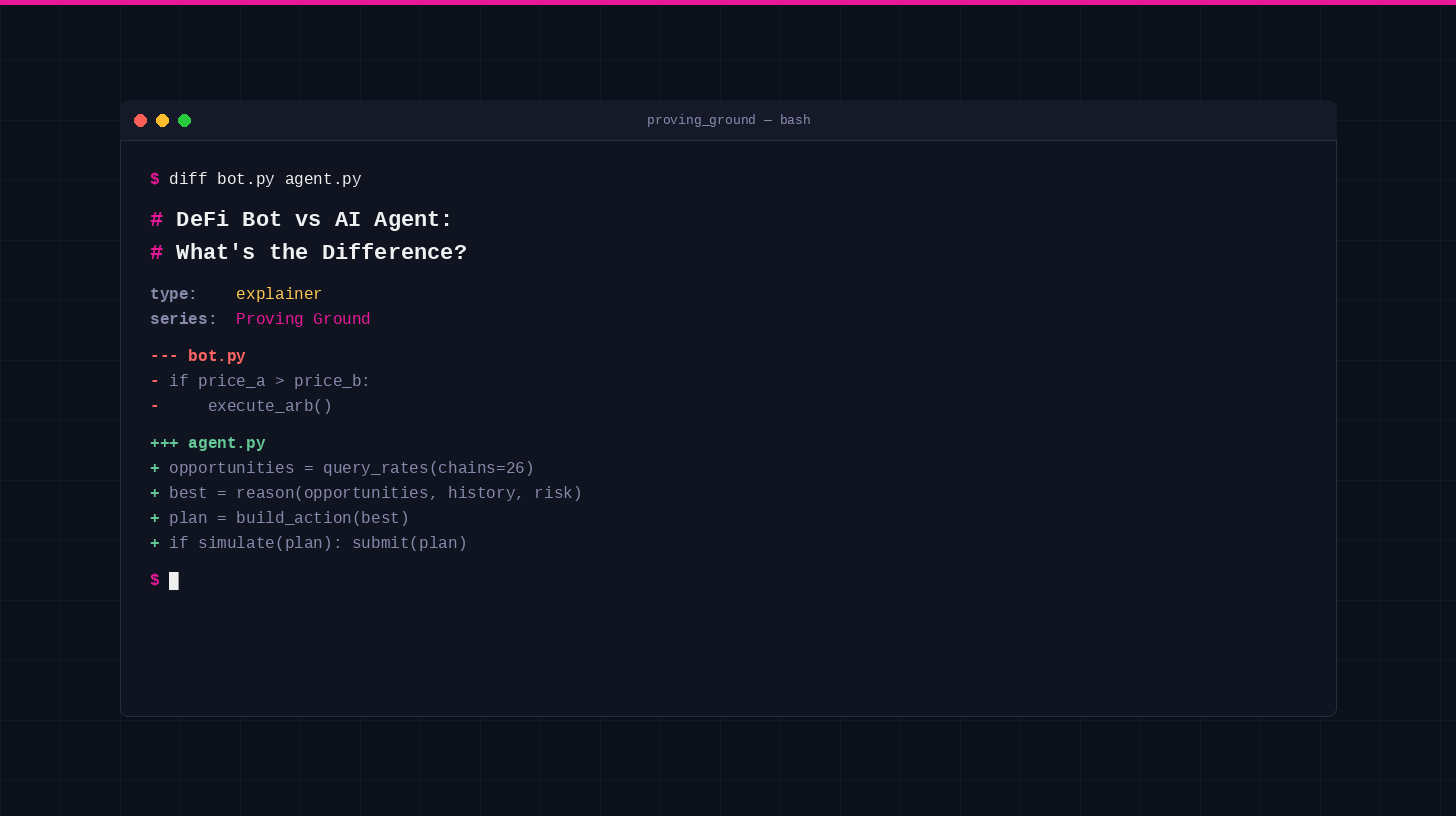
A DeFi bot is a script or program that executes predefined logic on-chain. Most of the automated activity you see today falls into this category, from arbitrage bots that spot price discrepancies across pools to liquidation bots that fire transactions when a position’s health factor drops below a threshold. MEV bots and automated market makers work the same way. They’re fast, deterministic and narrow by design, and none of them reason about what they’re doing.
They don’t evaluate whether a strategy is good, weigh alternatives or adjust their approach based on new information. They execute the logic they were programmed with, and they do it well.
AI Agents
An AI Agent uses an LLM or similar reasoning system to interpret context, evaluate options and decide what to do. Where a bot follows an if-then script, an Agent can look at a set of yield opportunities across multiple chains, factor in historical performance, gas costs, bridge fees and risk tolerance, then decide where to allocate capital.
Crucially, Agents can interact with external tools like CLIs and APIs as part of their reasoning. An Agent with access to a DeFi CLI can query rates, compare protocols, plan a transaction, simulate it and then execute, all within a single loop. If the simulation fails it can adjust its approach rather than just retrying or stopping.
The key difference is that an Agent’s behaviour is not fully specified in advance. It reasons its way to an action rather than executing a predetermined one.
Where the line gets blurry
In practice the boundary between bots and Agents is not always clean. A bot with enough conditional logic starts to look like a decision-maker. An Agent with a narrow enough prompt starts to look like a bot. Some systems combine both, using an AI Agent for high-level strategy and bots for the fast execution underneath.
The useful distinction is about adaptability. If the environment changes in a way the developer didn’t anticipate, a bot breaks or does nothing. An Agent can reason about the new situation and try something different. That adaptability is what makes Agents interesting for DeFi, where conditions change constantly and the number of protocols, chains and strategies is too large for any single script to cover.
Why this matters for infrastructure
Bots and Agents have different infrastructure needs. Bots need speed, low latency and reliable mempool access. Agents need structured data, safe execution environments and the ability to simulate before committing funds.
Most blockchain infrastructure today was built for bots (and before that for humans). The tooling assumes either a person clicking buttons or a script that knows exactly what it wants to do. Agents sit in between. They need the programmatic access of a bot but with richer context, safer defaults and the ability to explore before acting.
This is why projects like defi-cli are building Agent-first interfaces with features like simulation flags, structured JSON output and separated plan-and-execute lifecycles. These aren’t things a traditional bot needs, but they’re essential for an Agent that’s reasoning its way through a transaction.
Quick comparison
DeFi bot: Executes predefined logic. Fast and deterministic. Breaks when conditions change unexpectedly. Narrow by design.
AI Agent: Reasons about what to do. Slower but more adaptable. Can handle novel situations. Uses tools like CLIs and APIs to interact with protocols.
Both: Operate autonomously on-chain. Don’t require a human in the loop for execution. Are already active across DeFi today.
The shift from bots to Agents is not a replacement. Bots will continue to handle the fast, deterministic tasks they’re good at. But the decision-making layer on top, the part that decides which strategy to run, which chain to use, which protocol to trust, is moving toward Agents. That’s where infrastructure needs to catch up.