

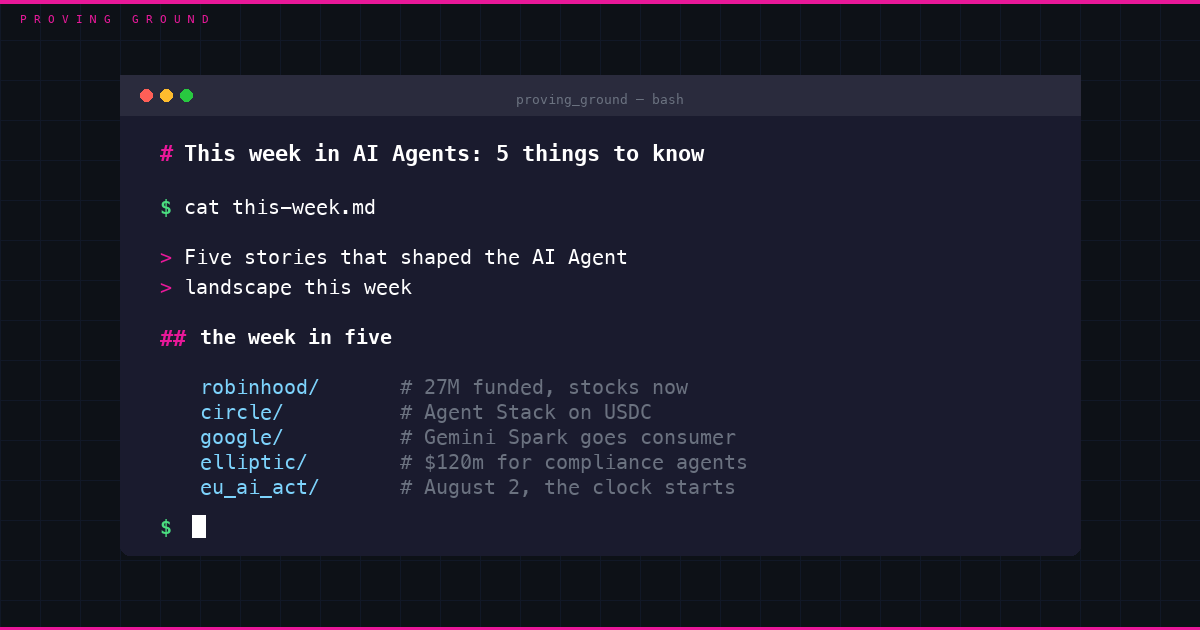
Robinhood opened stock trading to AI Agents, Circle shipped its Agent Stack on USDC, Google pushed Gemini Spark into the consumer Gemini app, Elliptic raised $120 million to put agents on the compliance stack and Brussels set August 2 as the EU AI Act’s enforcement date. Five stories that shaped the AI Agent landscape this week.
1. Robinhood opens stock trading to AI Agents for 27M customers
Robinhood opened its platform to AI Agents on May 27, letting any of its 27 million funded customers create a separate Agentic Trading account, fund it with a fixed balance and hand execution to an AI Agent, such as one built on Claude or ChatGPT, that can read the portfolio, suggest investments and place stock trades on its own. The beta is equities-only at launch. Options, crypto, event contracts, futures and prediction markets are next. The brokerage paired the launch with an Agentic Credit Card for Robinhood Gold members, a virtual card that lets an AI Agent scan the web for items and authorise purchases when a user’s price threshold is met. Users see every trade in the app and can be required to approve previews before larger orders execute.
The implication is that a publicly listed brokerage just made an AI Agent a first-class user of its platform, not an experimental wrapper. Once one major broker does this, the rest follow. The agentic customer is no longer a category waiting to exist.
2. Google ships Gemini Spark and Project Mariner at I/O
Google used I/O on May 19 to push AI Agents into the consumer Gemini app. Gemini Spark is a new general-purpose AI Agent that reasons across information in connected apps, available first to Google AI Ultra subscribers and trusted testers. Project Mariner, the company’s web-browsing agent first previewed last year, shipped alongside it. Google also released Gemini 3.5 Flash at $1.50 per million input tokens and $9 per million output, roughly a third the price of comparable frontier models like Claude Opus 4.6 and GPT-5.5, and kept pushing the Agent2Agent protocol and the Gemini Enterprise Agent Platform announced at Cloud Next.
The shape of the week is that consumer AI Agents are now the headline product at the world’s biggest software vendors, sitting next to search and messaging on the home screen. Whatever happens at the protocol layer, AI Agents are being normalised on the surfaces hundreds of millions of users open every day.
3. Circle launches its Agent Stack and a stablecoin rail to match
Circle announced Circle Agent Stack on May 11, a set of services for autonomous agents to hold assets and transact in USDC across blockchains. The stack ships with Circle CLI, Agent Wallets, an Agent Marketplace and Nanopayments powered by Circle Gateway, the company’s cross-chain liquidity layer. Stablecoin payments at sub-cent unit economics settle on chain under an AI Agent’s own credentials, with no human signing in the loop.
This is the largest US stablecoin issuer building its own rails for AI Agents to use, paired with developer tooling that does not assume a human is the one paying. It pushes Circle into the same lane AWS staked out earlier this month with AgentCore Payments. Whichever provider’s primitives become the default for autonomous spending will sit underneath a meaningful share of next year’s agent commerce.
4. Elliptic raises $120M to put agents on the compliance stack
Blockchain analytics firm Elliptic raised $120 million on May 12 in a round led by One Peak, with Nasdaq Ventures and Deutsche Bank participating, valuing the London company at $670 million. CEO Simone Maini said the funds will accelerate an agentic product roadmap that builds AI Agents on top of Elliptic’s compliance dataset to automate work currently done by analysts.
The story is not the funding round, it is what the funding round buys. The job of a compliance analyst, parsing alerts, tracing flows, deciding whether a transaction is suspicious, is exactly the work AI Agents are being trained to do, and the AML and KYC vendors are racing to be the ones whose AI Agents the regulated industry actually hires. Compliance is one of several professional categories that will look structurally different by this time next year.
5. EU AI Act enforcement and Colorado’s SB 189 mark a governance split
Two regulatory clocks shifted this week. In Europe, the EU AI Act’s high-risk obligations activate on August 2, after which incident reporting, auto-log retention, human oversight tooling and impact assessments become legally binding for deployers of high-risk AI systems. In the US, Colorado’s AI Act enforcement was stayed as of May 23 pending the outcome of SB 189, which is expected to be signed in June with a revised scope and a new effective date.
The result is a split between hard EU deadlines and a US patchwork that keeps moving. For AI Agents in particular, both regimes lean on the same operational question, whether you can prove an AI Agent’s actions were authorised by someone who had the right to authorise them. As we wrote earlier today, that question is the part of the agent economy nobody can verify yet. The teams shipping AI Agent products in the next twelve months will hit these regimes whether they planned to or not.
This post is exploratory and does not represent a specific roadmap.