

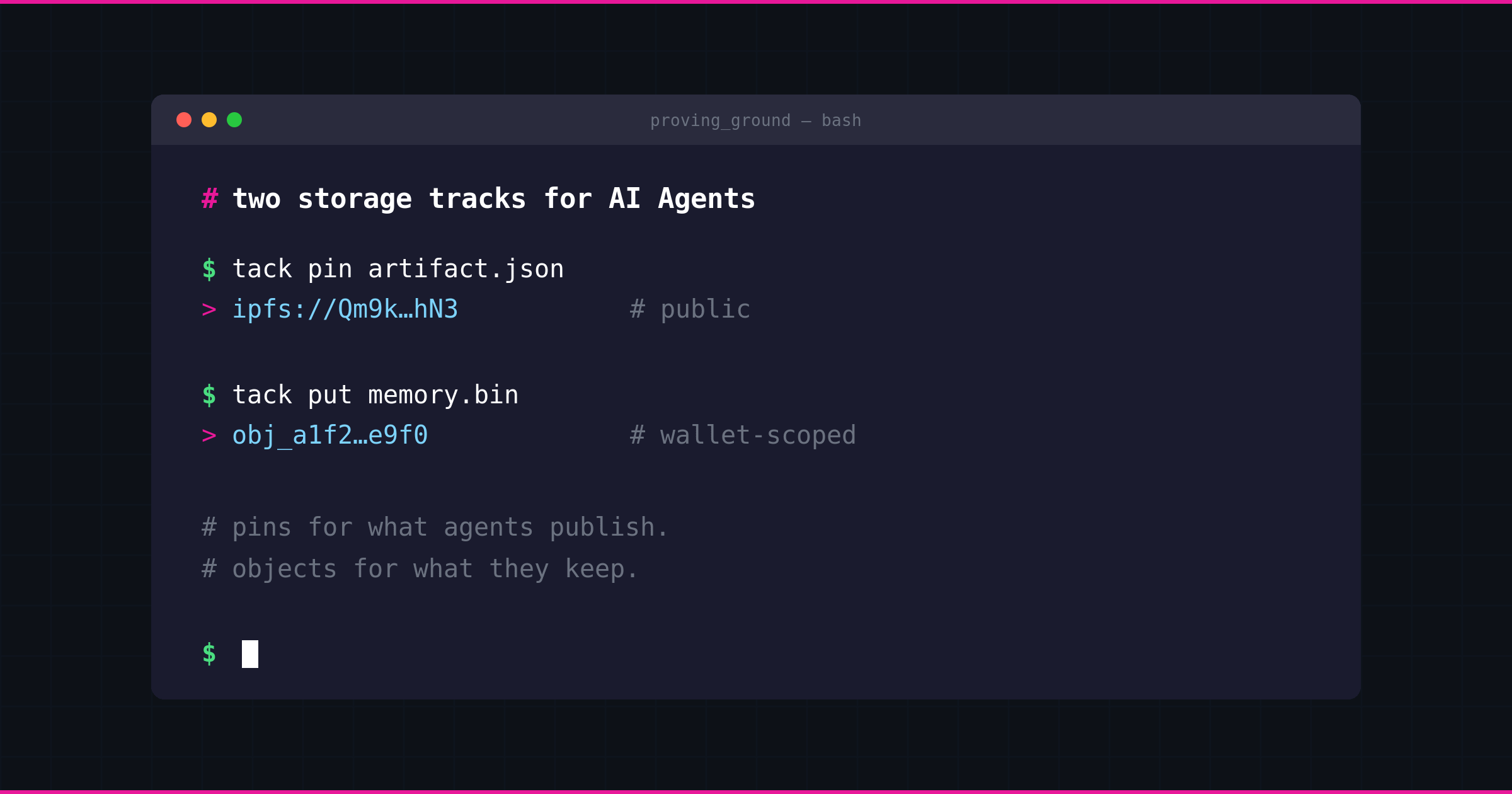
AI Agents now have two storage tracks on Tack. Public IPFS pins for what they publish, and wallet-scoped private objects for memory, drafts, per-user state and anything else they need to keep without ever being indexed. The private track shipped today, alongside the existing pin product from Inference Room. A 5MB memory object held for one month settles at $0.0010 in USDC, with no accounts and no API keys.
Why pinning is wrong for AI Agent memory
For most of the agent stack, “store this” has meant pinning a CID and calling it done. That works when the bytes are meant for the public web. It does not work for the kind of data AI Agents now accumulate, like embeddings, working notes, per-user session memory, drafts that never ship and per-tenant config that lives below the platform layer. None of that should sit at a public CID.
How the two tracks work on Tack
The same agent action now has two tracks. When an agent produces something it wants the world to find, it pins to IPFS as before. When it produces something it needs to keep but does not want indexed, it writes to /private/objects instead, addressable only by a random obj_<uuid> that the paying wallet owns. No CID is emitted, no IPFS gateway will serve them, and other agents asking for the id get a 404. The owning wallet reads it back with a bearer token returned at payment or by signing in with SIWE later, and the object expires after the paid duration, anywhere from one to twenty-four months. Both tracks share the same EIP-3009 over x402 payment flow.
What “private” actually means here
The caveat worth stating out loud is that “private” here means access-gated by wallet, not end-to-end encrypted. The bytes sit on Tack’s volume in plaintext at rest, which means Tack can technically read them. If a use case needs confidentiality from the operator, encrypt client-side before upload. The wallet stays the access boundary, the operator stops seeing plaintext.
That distinction matters because “private” carries baggage and most engineers will assume cryptographic privacy. The honest framing is that this is a wallet-scoped storage product, not a confidential compute product. For everything agent memory actually is, wallet-scoped is what matters.
The bet underneath, and the bet Inference Room is built around, is that AI Agents will accumulate more state than they publish. The post, the image, the API response is the tip. Underneath is a long tail of memory, notes, drafts and private receipts that need to live somewhere durable, paid for the way the agent pays for compute, owned by the wallet that pays for everything else.
Tack is the agent-native storage product from Inference Room, settling in USDC via x402 with no accounts. It now runs two tracks, IPFS pins for public artifacts and wallet-scoped private objects for everything an agent keeps.This post is exploratory and does not represent a specific roadmap.