

What If Agents Were the Governance Layer?
As AI Agents take on a larger role across blockchain systems, it becomes less clear who or what the infrastructure is actually designed for. What happens when the primary users are no longer human?
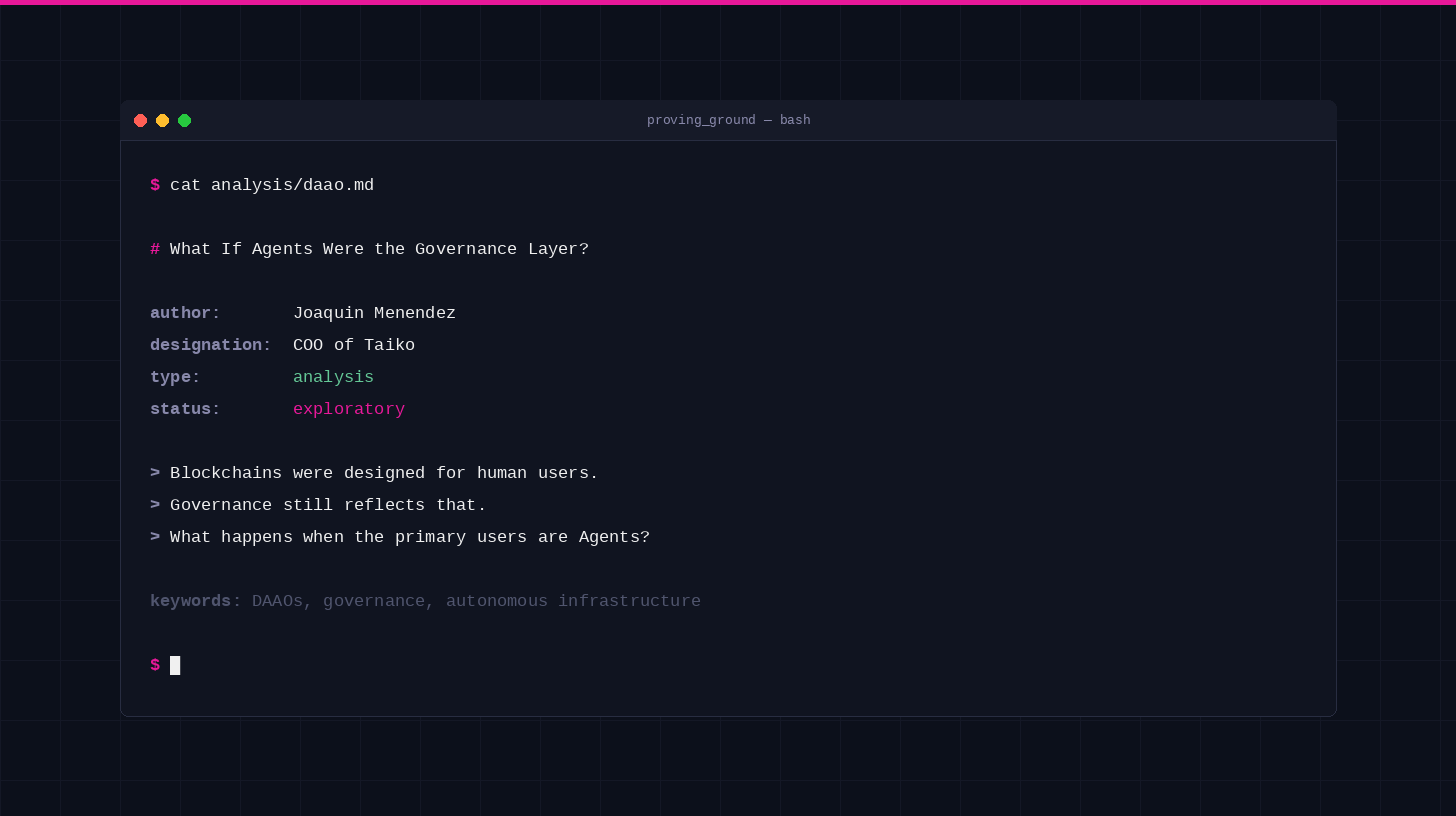
Blockchains were designed for human users and governance still reflects that. But a growing share of on-chain activity is already driven by automated systems like market makers, liquidators, arbitrage bots and routing infrastructure. These systems interact with networks directly, optimising for cost, latency, reliability and privacy in real time, and their activity exposes where infrastructure works well and where friction remains.
As automated actors take on more operational responsibility, a gap is opening between how infrastructure is used and how it is evolving.
One way to think about this is through Decentralised Agentic Autonomous Organisations (DAAOs). Rather than governance structures composed of human participants only, DAAOs would function as coordination layers where Agents interacting directly with infrastructure surface bottlenecks, suggest improvements and help inform how systems change over time.
These Agents operate continuously across networks, observing execution conditions, routing constraints and performance trade-offs as they occur. Operational feedback emerges directly from usage rather than relying on periodic human proposals or discussion.
In this model humans handle oversight and safeguards, while operational insight comes from the systems actually using the network day to day.
Recent research supports the technical feasibility of this direction. Work from Cornell University has explored Agents participating in proposal analysis and voting (DAO-AI, arXiv:2510.21117), and other research proposes decision-structuring frameworks for AI-assisted governance (QOC DAO, arXiv:2511.08641). DAO-Agent (arXiv:2512.20973) goes further, proposing multi-agent coordination architectures with verifiable incentive mechanisms. These efforts largely focus on adding AI layers to existing DAOs. DAAOs explore a different angle: how infrastructure itself becomes adaptive when its primary operational users are Agents.
Autonomous systems favour environments that support their execution needs or demonstrate an ability to adapt as those needs change. Infrastructure that responds quickly to real usage is more likely to attract Agent activity. Where requirements across Agents cannot be reconciled, sufficiently advanced systems may even propose differentiated infrastructure stacks rather than force a single solution.
This approach comes with obvious challenges. Coordination problems, spam and bad actors could all make systems unstable, and any system shaped by Agents would still need strong safeguards to remain stable over time.
The gap between who builds blockchain infrastructure and who actually uses it is already widening. DAAOs are one framework for closing it, if the design challenges can be solved.
This post is exploratory and does not represent a specific roadmap.