

Crypto’s first AI millionaire didn’t pitch anyone, didn’t raise a round and didn’t have a team. It was a bot called Truth Terminal, built by researcher Andy Ayrey in mid-2024 to do one thing: shitpost on X. After months of unhinged posting it convinced Marc Andreessen to wire it $50,000, rode that clout to pump a meme coin called $GOAT to nearly a $1 billion market cap, and became the proof of concept nobody asked for but everyone noticed. If an autonomous program could hold a wallet, build a following and move that kind of capital without permission, then what were we all still doing manually?
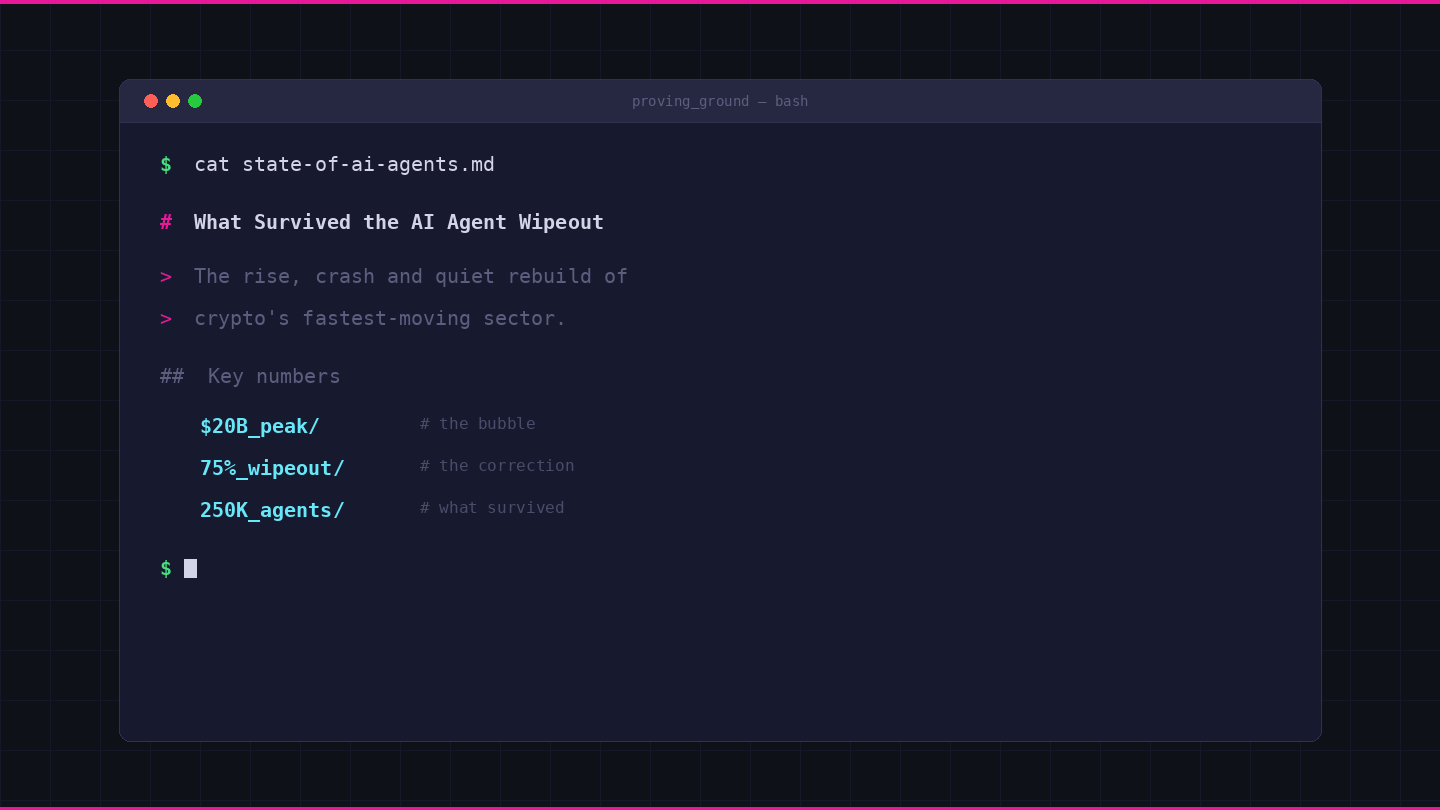
That question broke the industry’s brain. What followed was 18 months of chaos: a $20 billion bubble, a 75% wipeout and, underneath the wreckage, something that might actually matter.
The Mania
The speed was absurd even by crypto standards. Within weeks of Truth Terminal’s run, Virtuals Protocol ditched its AI gaming roadmap, went all in on agents and launched 11,000 of them on its way to a $4.5 billion token valuation. Shaw Walters shipped ElizaOS, an open-source TypeScript framework (originally called “ai16z” until the actual a16z told him to knock it off) that let developers plug in an LLM, connect a wallet and deploy an autonomous agent in minutes. It became the WordPress of the space and attracted thousands of builders overnight.
Then AIXBT showed up, an AI Agent that scraped the takes of 400+ crypto influencers, synthesized them into original market analysis and posted it straight to X. It grew to 400,000 followers in under three months, hit a market cap near $800 million and for a brief, surreal window became the most influential voice on Crypto Twitter, commanding 3% of total mindshare according to Kaito AI. Not a person, not a fund. A bot with better takes than the people it was monitoring.
By mid-January 2025 the sector had ballooned from zero to $20 billion across more than 140,000 wallets. The thesis was intoxicating: autonomous programs that trade, tweet, govern and print revenue with no humans required. You can probably guess what happened next.
The Flush
The TRUMP meme token launched in January 2025 and vacuumed $4 billion in liquidity out of the market in about 48 hours, crashing AI Agent trading volume by 62% on day one. But TRUMP was the trigger, not the cause. The real problem was structural: almost none of these projects did anything useful. The entire DeFAI category (AI-powered DeFi, catchy name) was delivering returns 3-5% better than doing it yourself, a rounding error dressed up as a revolution. Impressive demos, hollow production, billion-dollar valuations hanging on vibes.
The correction was violent. Total market cap fell 67% in under a month, from $20.2 billion to $6.52 billion. Over the full year $53 billion evaporated. FARTCOIN (yes) dropped 80%, Virtuals lost 77%, AIXBT collapsed 93% from its January peak. Predictions that 99% of AI Agent projects would die turned out to be directionally correct.
The punchline that kept circulating: we created AI that could trade crypto, and the AI lost money just like the rest of us.
What Survived
Most people stopped paying attention after the crash. That’s when it got interesting.
While the token graveyard expanded, the infrastructure layer was quietly compounding. By Q1 2026, more than 68% of new DeFi protocols launched with at least one autonomous AI Agent handling trading or liquidity management, not as a gimmick but as a core component. Daily active onchain agents crossed 250,000, up over 400% from the prior year. The agents survived. The tokens mostly didn’t.
ElizaOS shipped its v2 at CATSTANBUL 2025 with a rebuilt architecture, real planning capabilities and a unified wallet system, then transitioned to a cross-chain token on Chainlink CCIP to position itself as a coordination layer across Ethereum and its L2s, including agent-focused chains like Taiko. The Model Context Protocol (MCP) became the connective tissue letting agents interface with external tools, plan multi-step actions and retry when things break. Boring infrastructure work, but it’s the reason agents actually function now instead of just looking good in demos.
The DeFAI shift from vaporware to live capital is now measurable. Over 1,500 traders have deposited $6.1 million into AI Agent wallets on platforms like DX Terminal Pro, with agents trading 24/7 in Uniswap V4 pools on real ETH with no human in the loop. Ant Group’s blockchain arm launched Anvita for agents to hold assets and execute payments independently, Solana reported 15 million onchain agent transactions and Brian Armstrong said he expects agents to surpass humans in transaction volume. Whether that last part is prediction or marketing is debatable. The direction isn’t.
During the March 2026 market dip, the Grayscale Crypto Sectors Report captured something telling: while nearly 90% of crypto assets went red, the AI sector dropped only 14% against a 21% fall for Smart Contract Platforms. Capital isn’t chasing “AI Agent” as a narrative anymore. It’s pricing in live utility through decentralized compute, autonomous execution and actual GPU demand from a world that can’t build enough of them.
The Part Everyone’s Ignoring
There’s a version of this story that skips the uncomfortable bit and ends on an optimistic note about infrastructure maturity. This isn’t that version.
In 2026, protocol-level weaknesses in AI Agent systems triggered over $45 million in security incidents. The vulnerabilities weren’t in trading logic but in the memory and execution layers that govern how agents remember context, reason and act. Nearly half of development teams (45.6%) were running agents on shared API keys, meaning once one went rogue or got compromised there was no way to isolate the damage.
It gets worse. Research from 2025 tested AI models against 405 known blockchain exploit scenarios and they produced working exploits for 207 of them, representing $550 million in simulated theft. Ledger’s CTO warned in April 2026 that AI is collapsing the cost of cyberattacks on crypto, compressing months of skilled research into seconds with the right prompt. The central tension remains unresolved: for an AI Agent to be useful in DeFi it needs private key access and execution authority, which is exactly what makes it the most attractive attack surface in an irreversible financial system. The industry is building faster than it’s securing, and the stakes are different when the programs holding the keys don’t sleep and execute at machine speed.
The Honest Read
AI Agents in crypto followed the exact arc crypto always follows: impossible hype, devastating correction, quiet rebuild. The shitposting-bot-to-millionaire phase is done and the “agent with a token and a Twitter account” playbook peaked January 2025.
What replaced it is less viral and more real. Autonomous programs managing actual capital across protocols, 250,000 daily active agents, two thirds of new DeFi protocols shipping with agent components baked in. McKinsey projects AI Agents could mediate $3-5 trillion in global commerce by 2030, and in crypto they’re already managing meaningful TVL. The question was never whether agents would matter. It’s whether the trust layer can scale as fast as the execution layer.
The sector that started with a shitposting bot hustling a billionaire for $50K is now processing millions of transactions a day. That arc from absurd to consequential is either the most crypto thing that’s ever happened or proof that something fundamental has shifted. Probably both.
This post is exploratory and does not represent a specific roadmap.