


If you ask most people where AI Agents will live, they’ll say “the cloud.” And they’re not wrong exactly, but they’re missing half the picture. The moment an AI Agent touches money, owns assets or makes commitments on someone’s behalf, it needs more than a server. It needs a blockchain. And not just any blockchain. It needs a rollup.
Here’s why.
Agents are economic actors now
The first generation of AI Agents lived inside chatbots and customer support widgets. They processed language, not value. But the current generation is different. These agents trade tokens, provide liquidity, manage portfolios and execute transactions across DeFi protocols without waiting for a human to click “confirm.”
When an agent moves $50,000 from one lending pool to another at 3am because it spotted a better yield, that action needs to be verifiable. Not “trust me, I did the right thing” verifiable. Cryptographically, publicly, permanently verifiable. That’s what a blockchain gives you: a shared ledger where anyone can audit what an agent did, when it did it and whether it followed the rules it was supposed to follow.
The problem is that running these operations on Ethereum mainnet is expensive. A single swap can cost $5-50 in gas depending on congestion. An agent making dozens of decisions per day would burn through its operating budget on transaction fees alone. Agents need blockchain-grade security without blockchain-grade costs.
That’s the case for rollups.
What a rollup actually gives an agent
A rollup processes transactions off Ethereum’s main chain but inherits its security by posting compressed transaction data back to L1. For AI Agents, this architecture solves three problems at once.
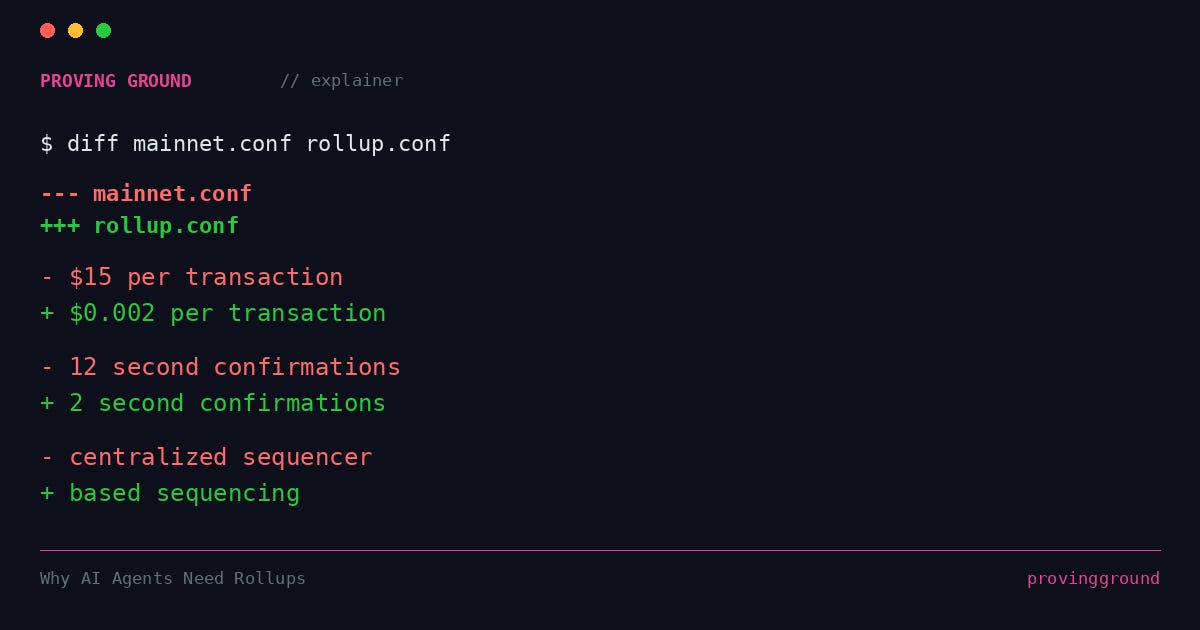
Cost. Transactions on a rollup cost fractions of a cent. An agent that rebalances a portfolio ten times a day doesn’t care about $0.002 per transaction. It very much cares about $15. Low fees turn agents from expensive curiosities into economically viable workers.
Speed. Rollups confirm transactions in seconds, not minutes. For an agent monitoring a volatile market and trying to capture a fleeting arbitrage opportunity, the difference between a 2-second and a 12-second confirmation window is the difference between profit and a missed trade.
Verifiability. Every action the agent takes is recorded on-chain and ultimately secured by Ethereum. If an agent claims it executed a trade at a certain price, anyone can verify that claim. This is the foundation of trust for autonomous software that handles other people’s money.
Why not just use Ethereum directly?
You could. But think about what happens at scale. One agent making ten transactions a day is manageable. A thousand agents each making a hundred transactions a day is 100,000 transactions, and that’s a conservative estimate for where this is heading. Ethereum mainnet processes roughly 15 transactions per second. The math doesn’t work.
Rollups are designed for exactly this kind of throughput. They batch hundreds or thousands of transactions together, compress them and post a single proof back to Ethereum. The agents get the speed and cost they need. Ethereum gets to stay secure without drowning in agent traffic.
The Taiko approach
Taiko is a based rollup, which means it uses Ethereum’s own validators for sequencing rather than running a separate centralized sequencer. For AI Agents, this matters because it removes a single point of failure from the stack. If your agent’s entire economic life depends on one sequencer operated by one company staying online and behaving honestly, you’ve reintroduced the centralisation risk that blockchain was supposed to eliminate.
Based sequencing also means Taiko inherits Ethereum’s liveness guarantees. If Ethereum is running, Taiko is running. An agent built on Taiko doesn’t need to worry about sequencer downtime or censorship, it just needs Ethereum to keep doing what Ethereum does.
This is why Taiko is building specifically for the AI Agent use case. The combination of low cost, fast confirmation, Ethereum-grade security and decentralised sequencing creates an environment where agents can operate autonomously at scale without the compromises that make other execution environments risky or expensive.
What this means practically
If you’re building an AI Agent that interacts with DeFi, you need an execution environment that is cheap enough for frequent transactions, fast enough for time-sensitive operations and transparent enough for users to trust an autonomous system with their assets. You also need that environment to be credibly neutral and resistant to censorship, because an agent that can be front-run or censored by the infrastructure it runs on isn’t really autonomous.
Rollups solve the cost and speed problem. Based rollups solve the trust and neutrality problem. That’s the thesis in one sentence.
The agents are coming regardless. The question is where they’ll settle their transactions and whose security guarantees they’ll rely on. Rollups built for this workload, not retrofitted for it, are going to be the answer.
This post is exploratory and does not represent a specific roadmap.