

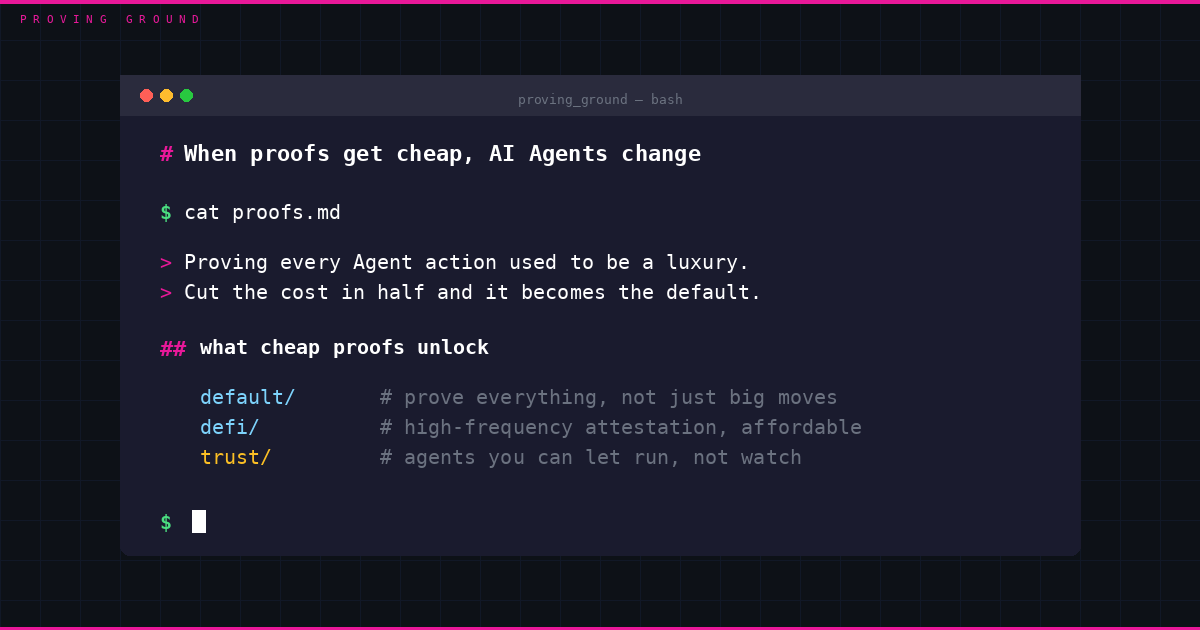
ZK proof costs just dropped by up to half, and that is more interesting for AI Agents than it sounds. A verifiable AI Agent is only as trustworthy as the record it leaves behind, and the strongest record is a ZK proof of what the Agent actually did. The catch was always cost, because proving every action continuously used to cost more than the actions were worth, so verifiability got rationed to the few moves big enough to justify it. When the per-proof price falls far enough, that arithmetic flips, and proving every AI Agent action becomes economically rational rather than a luxury reserved for high-value transactions. The recent Boundless Surge upgrade is the concrete trigger here, cutting proving costs by up to 50% and adding 25% more proving capacity, but the point worth exploring is what a cost drop like that unlocks for the agent category as a whole.
Why proof cost was the ceiling on verifiable AI Agents
The agent category has been stuck on a simple arithmetic problem. An AI Agent that acts autonomously is only as trustworthy as the record it leaves behind, and a ZK proof is the strongest record there is because it shows the Agent did exactly what it claimed without anyone having to take its word for it. The trouble was that proving every action continuously cost more than most of those actions were worth, so verifiability became a luxury reserved for the moves big enough to justify it. That is why so much agent tooling built over the past year leaned on selective verification or trusted execution rather than proving things outright, because the per-proof economics did not pencil out when an Agent’s work required continuous on-chain attestation. Cost was the ceiling, and it sat low enough that most teams either skipped the proof step entirely or settled for verifying only their highest-value actions.
What changes when proving every action is cheap
Lower the per-proof price by half and the default flips. Instead of asking which actions are valuable enough to prove, a team can prove everything an Agent does and treat the full execution trace as verifiable by default. That is a different product, because an Agent whose every step carries a proof can be audited, trusted and composed with by other Agents without anyone extending good faith. The proof step stops being the line item that decides whether the product ships, and verifiability moves from a feature you ration to a property the Agent simply has. For a category whose entire promise rests on Agents acting on your behalf without supervision, making continuous proof affordable is the difference between agents you have to watch and agents you can actually let run.
Which products come back into range
When proving every action becomes cheap enough to be the default, a set of products that were previously uneconomic come back into range. Verifiable AI Agents that need to prove their work on chain without proof costs eating the margin are the clearest example, since the thing that made them expensive was never the model or the execution, it was the cost of attesting to what the Agent did often enough to be trustworthy. High-frequency proof use cases sit right alongside them, because DeFi strategies, oracle attestations and cross-chain messaging all generate far more provable events than any team could previously afford to prove. Cheaper proofs do not just make existing products marginally better, they change which products can be built at all, and the ones that benefit most are exactly the high-frequency, continuously attesting workloads that AI Agents tend to produce.
Why this is the moment worth watching
A year ago the per-proof cost was the bottleneck for the whole agent category, because the economics broke down the moment an Agent’s work required continuous on-chain attestation. Cutting that cost in half does not solve every problem in the space, but it moves the floor far enough that proving every action becomes a reasonable default rather than an expensive exception, and that single change quietly expands what a verifiable AI Agent is allowed to be. The interesting question is no longer whether agents can prove what they do, it is what teams build once proving everything is finally cheap enough to assume.
Cheaper ZK proofs matter for AI Agents because they turn continuous on-chain verifiability from a cost you ration into a default you can assume, which is the precondition for AI Agents that act autonomously and still leave a record anyone can trust.
This post is exploratory and does not represent a specific roadmap.